Sunday, Jun 14, 2026
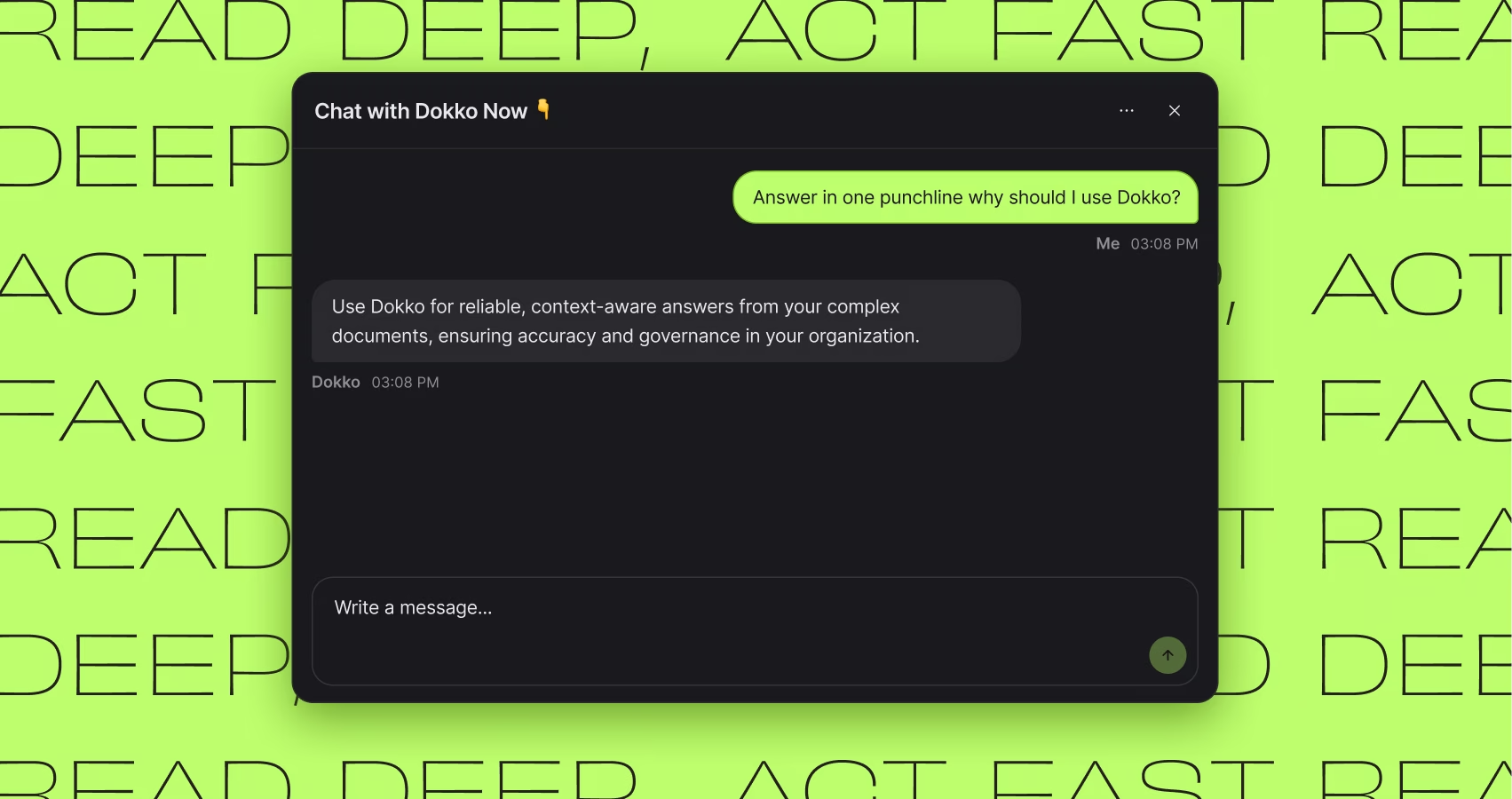
The new Dokko: Read deep, act fast
The new Dokko reads deeply into your most complex documents and, for the first time, acts on what it finds — no-code Skills, 250+ ready integrations, and your own systems, all inside your own cloud.
For a couple of years now, Dokko has done one thing very well: you point it at your content, and it answers questions about that content — in plain language, with the source attached, in whatever language the person happens to be typing. That has quietly become the boring, dependable core of a lot of support desks, intranets, and product help centres.
The version we’re shipping now does two things very well. It still answers — but it reads far deeper into the messy, real documents your business actually runs on, and for the first time it can act on what it finds. Two verbs, and they’re the whole story: read deep, act fast.
Here’s the shift in one sentence. An assistant that only answers tells someone “you can cancel that in settings” — and you still have the ticket. An assistant that acts just cancels it. That line between deflecting work and eliminating it is the thing the new Dokko is built to cross.
Read deep: Reliable answers over documents that fight back
The dirty secret of most document AI is that it assumes your documents are clean. They aren’t. They’re 200-page contracts, decade-old manuals, spreadsheets with meaning encoded in their layout, scanned PDFs, tables, diagrams. Generic retrieval chops all of that into fragments, and the fragments lose the thread. You get an answer that’s fluent, confident, and wrong — which is worse than no answer, because someone believes it.
We spent most of our engineering effort on exactly this problem, because it’s where these projects quietly fail. A few of the things that changed:
Chunks that remember what they’re about. Before Dokko stores a piece of a document, it enriches that piece with the context around it. So a line that reads “it grew 12% year over year” still knows what it was and when — instead of floating loose as a number attached to nothing. On long, structured documents — the enterprise case — that one change is the difference between finding the clause buried on page 187 and confidently quoting the wrong paragraph.
Real documents, not just clean text. Tables, scanned pages, and images are read by a vision model, not scraped by a brittle text-extractor that turns a table into word soup. Spreadsheets are understood as structured data. The hardest version of this is a question you can only answer by reading a document’s layout — a figure that lives in the third column of a table on a scanned page. That’s exactly the case below.
Metadata you define, not just the text on the page. Two documents can say similar things and still be completely different: one is the 2024 policy, the other is superseded; one applies to Germany, the other to Austria; one is internal-only. Dokko lets you define your own metadata fields — effective date, region, product, department, whatever your business runs on — and annotate your content with them. It isn’t decoration: those fields become how Dokko scopes an answer to the right documents.
The right answer, not a related one. Retrieved passages are re-scored against the whole question, so the best answer rises to the top rather than the one that merely shares a keyword. And people ask in plain language — “what changed in the German policy this year?" — and Dokko scopes the search itself, using the metadata above to filter down to the documents that apply. No query syntax, no filters to learn.
Answers you can defend. Everything comes only from your content; Dokko won’t invent. Every answer carries a clickable citation back to the source, so there’s always a paper trail — the kind you’d want in front of an auditor.
None of this is a demo in a sandbox. It’s the part of Dokko that’s live and doing this today.
In your users' language
Enterprises aren’t monolingual, and neither are their documents. Dokko answers in the language the person is using and stays there — no drifting back to English halfway through a conversation. It also works across languages: the source material can be in one language and the question in another, and the answer still lands. And when someone wants to switch, they just ask.
Act fast: From answering to acting
This is the leap. Answering reduces tickets; acting eliminates them — and opens entirely new value: booking, ordering, looking something up, updating a record. Getting there took solving a few genuinely hard problems, and we deliberately made the result something your team configures, not something we hand-build each time.
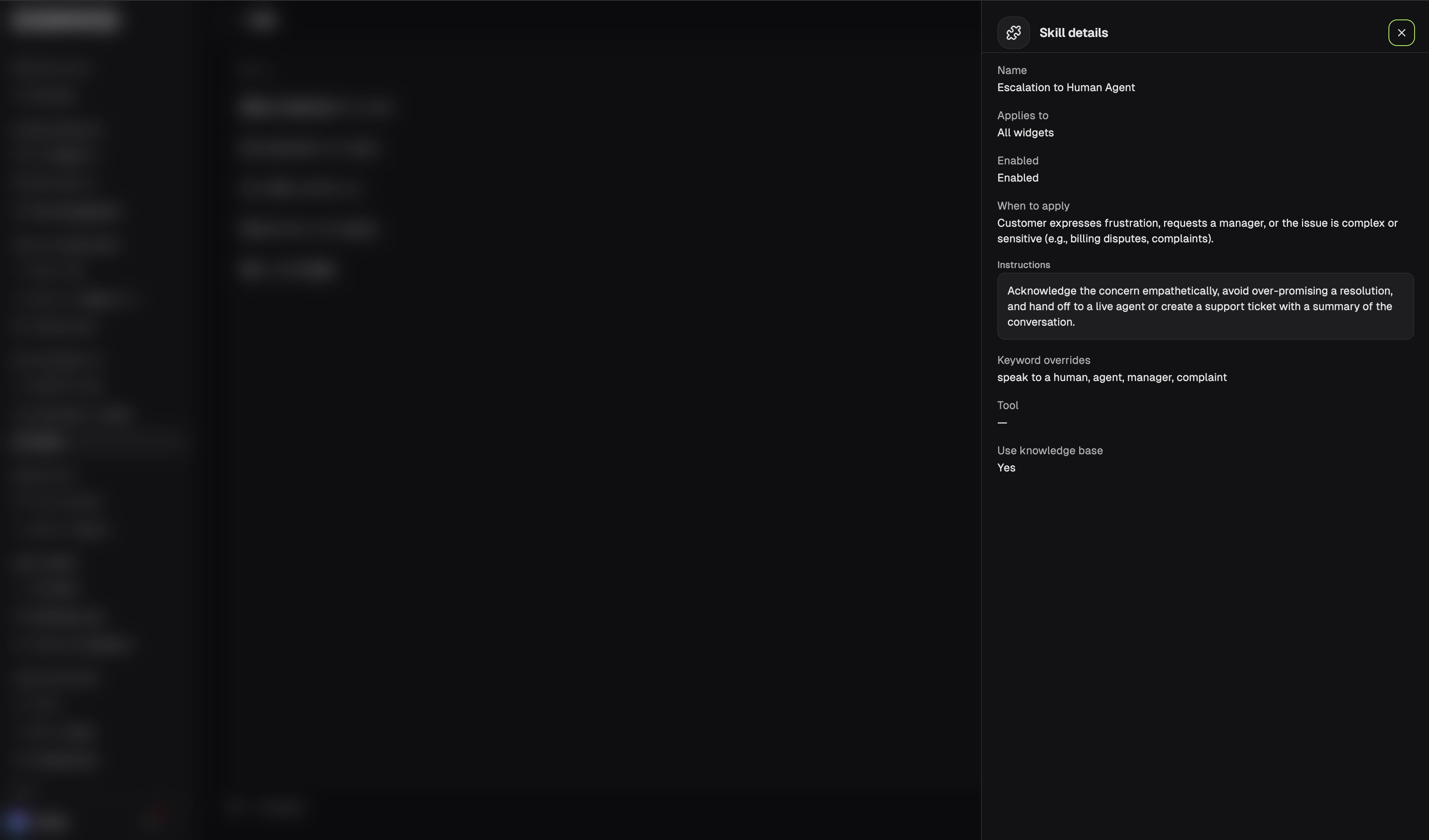
Skills — behaviour you configure, no code. A Skill is a named behaviour for a situation: “when a user asks about delivery, do this." Your team defines it, without writing code, and scopes it to the right audience. Dokko activates the right Skill automatically, in any language — the person never picks a mode or a menu.
Getting the inputs right — the unglamorous hard part. To act, the assistant needs complete, correct inputs, and people never hand them over all at once. Dokko gathers what’s missing conversationally, converts the fuzzy stuff into the exact stuff — “the next two weeks” becomes real dates, kilograms and centimetres are normalised — and it will not guess a value it wasn’t given. It acts only when it actually has everything.
Tools — 250+ ready-made integrations. Connect the assistant to the systems your business already lives in — Gmail, Google Calendar, Slack, HubSpot, Salesforce, Jira, Notion, GitHub, and hundreds more. There’s no integration project: switch one on, authorise it once, attach it to the assistant. Authentication is managed and secure — Dokko never holds your users' credentials. And for the things only you have — a pricing engine, an internal booking system, a bespoke workflow — you connect your own systems the same way. A ready-made catalogue and a path for the parts that are uniquely yours.
Acting safely. Actions are scoped, controlled, and logged — you can see what the assistant did and why. It’s hardened so a malicious document or a tool’s response can’t trick it into doing something it shouldn’t, and higher-impact actions can require a human confirmation before they run.
A platform you can run a business on
Reading deep and acting fast only matter if the thing holds up under real load, for real organisations. Dokko was built multi-tenant from day one — many brands, departments, or customers on one platform, each isolated from the others. It runs inside your own cloud, so your data stays your data. Responses stream back fast, and ingestion and answering run in parallel so it stays responsive while it’s working. It’s GDPR-friendly by design, down to a self-hosted, privacy-respecting bot protection that sends no user data to third parties, with abuse and usage controls built in.
One more thing worth saying: it’s a single pipeline behind more than one product. The same ingested knowledge powers both the conversational assistant and a fast site-search widget. Content gets in by crawling your website, connecting to gated intranets, or direct upload — and your own systems can feed Dokko automatically, with no manual re-uploading.
What’s here, and what’s next
We’d rather be straight about status than blur it.
- Today, live: deep, reliable answers over complex content — multilingual, cited; custom metadata; the site-search widget; flexible ingestion; the multi-tenant platform.
- Now in beta, generally available in August 2026: Skills and Tools — the acting layer, across the integration catalogue and your own systems.
- Next, shaped with partners: broader catalogue coverage, multi-step actions with confirmation, and deeper document understanding.
Let’s scope a pilot
The best way to see whether this fits your business isn’t a longer demo — it’s a small, real pilot. We take one business unit and its actual content, pick two or three high-value actions (say, a calendar, your CRM, and one internal system), and agree the success criteria up front: answer quality, action success rate, hours and tickets saved. Then we build it out together — you bring the use cases, we bring Dokko and the expertise.
If that sounds worth a conversation, tell us about your use case and we’ll set up a scoping session. You can also see the product at dokko.ai.
